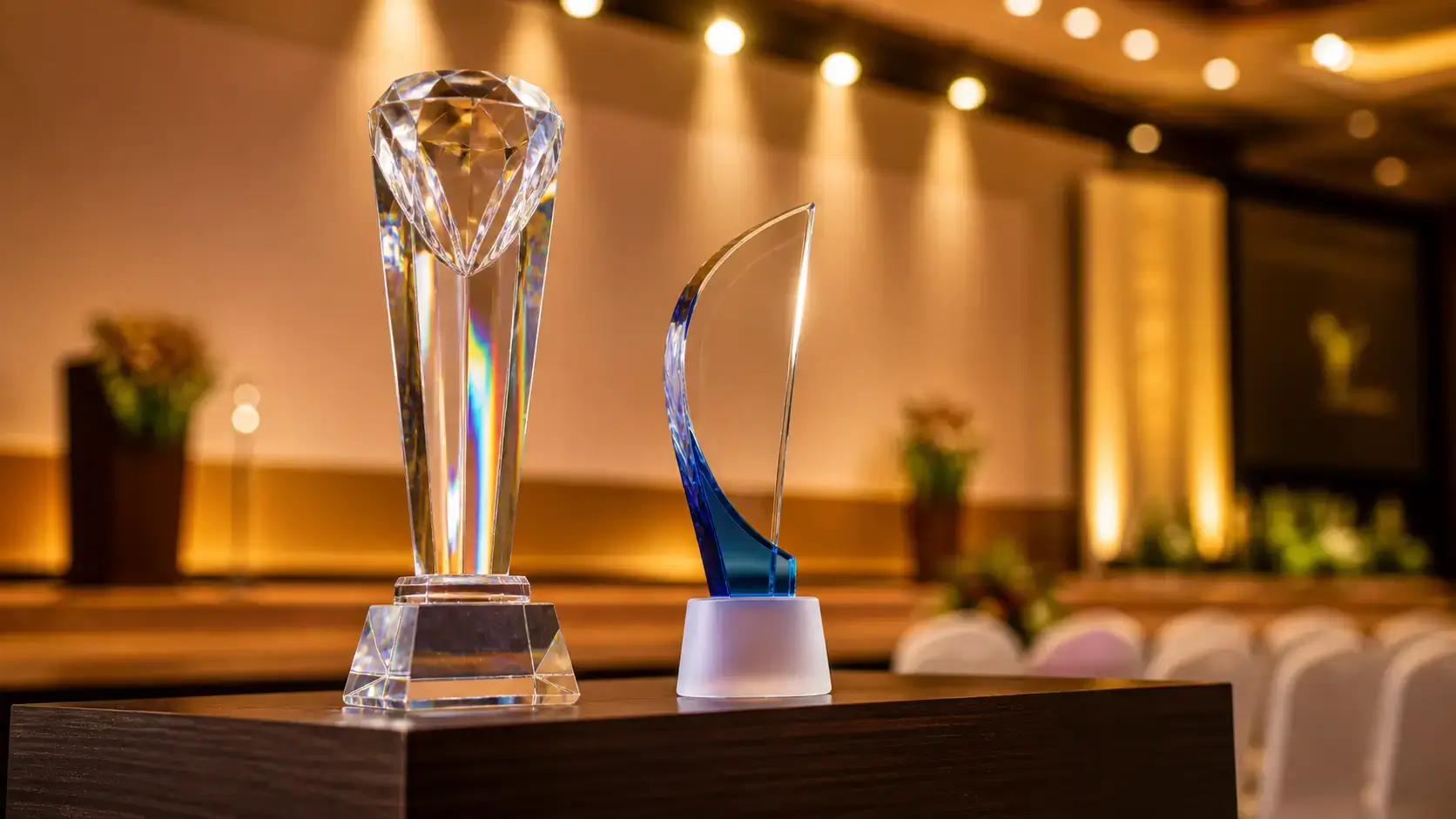
You’re planning an award ceremony. The HR head wants something that “feels premium.” The procurement team wants a price that fits the budget. And the recipient, well, they just want something they’d actually be proud to keep on their desk.
That’s where most corporate buyers get stuck. The crystal vs acrylic trophy debate isn’t just about looks. It’s about cost-per-unit at scale, how the award holds up in transit, what message it sends, and where it ends up six months after the ceremony.
This guide breaks down both materials side by side. Cost, durability, prestige, customisation, and bulk-order economics. By the end, you’ll know exactly which one fits your event, your budget, and your recipients.
Crystal vs Acrylic Trophy: The Quick Answer
Quick Answer: Crystal trophies are heavier, more refractive, and carry a prestige feel that suits senior recognition and milestone awards. Acrylic trophies are lighter, shatter-resistant, easier to customise, and cost significantly less, making them ideal for bulk corporate, school, and sports programmes. For most buyers ordering 25 or more awards, acrylic offers the better value-to-impact ratio. For top-tier individual recognition, crystal still wins.
That’s the short version. But the right answer for your specific event depends on a few more factors. Let’s break each one down.
What Is a Crystal Trophy Made Of?
Crystal is a type of glass with added lead oxide, typically 24 to 30 percent. That lead content is what gives crystal its distinctive weight and its famous light-refracting quality. Hold a crystal award up to the light and you’ll see the rainbow shimmer that plain glass simply cannot produce.
The manufacturing process is labour-intensive. Crystal needs precision cutting, polishing, and often hand-finishing. That’s why crystal sits at the premium end of the trophy market. It also explains why the same 8-inch design can take 10 to 15 days longer to produce in crystal than in acrylic.
In Indian corporate ceremonies, crystal trophies are typically chosen for chairman awards, lifetime achievement, retirement recognition, and top sales performer of the year.
What Is an Acrylic Trophy Made Of?
Acrylic is a synthetic polymer, technically a thermoplastic. You may know it by its trade names like Plexiglass or Perspex. Modern acrylic offers optical clarity that genuinely rivals glass, and it can be molded into shapes that crystal physically cannot achieve.
That moldability is acrylic’s biggest creative advantage. Custom 3D shapes, layered colour panels, frosted edges, even embedded logos. All possible in acrylic at a fraction of the cost of equivalent crystal work.
For bulk orders in India, acrylic is the workhorse. School annual days, corporate quarterly recognition, sports tournaments, conference appreciation pieces. Acrylic handles all of it without breaking the budget.
Crystal vs Acrylic: Side-by-Side Comparison
| Feature | Crystal Trophy | Acrylic Trophy |
| Material | Glass + lead oxide (24–30%) | Synthetic thermoplastic polymer |
| Weight (8-inch piece) | 4–6 lbs (heavy, premium feel) | 1–2 lbs (lightweight, easy to ship) |
| Light refraction | High — diffracts light, sparkles | Optically clear but no sparkle |
| Impact resistance | Low — shatters if dropped | High — 17x more impact resistant |
| Scratch resistance | High — hard surface | Lower — softer, scratches over time |
| Design flexibility | Limited shapes | Very high — any shape, any colour |
| Engraving | Sand-etching, sub-surface laser | Laser engraving, UV colour printing |
| Production time | 10–20 days for custom | 5–12 days for custom |
| Price range (India) | Rs.1,500–Rs.8,000+ per piece | Rs.250–Rs.1,500 per piece |
| Bulk discount potential | Limited — labour-intensive | Strong — moulds enable scale |
| Best for | Senior leadership, milestones | Quarterly, school, sports events |
This table alone settles 80 percent of buyer questions. But cost and customisation deserve a closer look.
Cost Breakdown: Per-Unit Pricing in India
Here’s where the maths gets interesting. The headline price difference is significant, but the gap widens further at scale.
| Order Quantity | Acrylic (per unit) | Crystal (per unit) | Total Saving (Acrylic) |
| 10 pieces | ~Rs.600 | ~Rs.2,000 | Rs.14,000 |
| 50 pieces | ~Rs.450 | ~Rs.1,800 | Rs.67,500 |
| 100 pieces | ~Rs.350 | ~Rs.1,600 | Rs.1,25,000 |
| 500 pieces | ~Rs.280 | ~Rs.1,400 | Rs.5,60,000 |
These ranges reflect typical mid-tier customisation with logo engraving. Premium designs run higher in both materials. What matters is the slope. Acrylic per-unit cost drops faster as quantity climbs because moulds spread their setup cost across more pieces. Crystal stays expensive because every piece still needs hand-finishing.
For most corporate recognition programmes, the recognition impact stays roughly constant regardless of material, but the acrylic trophy price in India lets you recognise three to five times more people for the same budget. That’s not a small consideration.
Pro tip: If your annual awards budget is Rs.2 lakh and you’re choosing between 100 acrylic pieces or 25 crystal pieces, the acrylic option creates four times more recognition moments. For most cultures, broader recognition outperforms exclusive prestige.
Ready to plan your next ceremony? Request a quote from Bombay Trophies and our team will help you balance prestige and budget across your award tiers.
Customisation and Engraving Options
Both materials accept personalisation, but they handle it differently.
Crystal customisation typically uses three techniques. Sand-etching produces deep, frosted text and logos with crisp definition. Sub-surface laser engraving creates 3D images inside the crystal block, ideal for company logos or portrait silhouettes. Diamond-cut polishing finishes the edges with that signature crystal sparkle.
Acrylic customisation is far more flexible. Laser engraving produces clean, sharp text and graphics. UV colour printing lets you embed full-colour logos, photos, or branded artwork directly onto the acrylic surface. And because acrylic can be cut, molded, and bent into any shape, the design itself becomes a customisation tool. Custom outlines, layered panels, and embedded inserts are all standard options.
For brands with strong colour identity, acrylic wins on creative range. For brands that want classic elegance with no visual competition, crystal still leads.
When to Choose Crystal Over Acrylic
Crystal earns its premium price in specific situations. If your recognition matches any of these scenarios, crystal is worth the investment.
- Lifetime or retirement awards. When you’re honouring decades of service, the recipient deserves something that says decades. Crystal carries that weight, literally and symbolically.
- Chairman or CEO-level awards. Senior recognition demands prestige. Crystal photographs better in stage shots and reads more impressive in press coverage.
- External brand-impact awards. Industry awards, partner recognition, client appreciation events where the award becomes part of the recipient’s office credibility wall.
- Limited-quantity programmes. If you’re awarding fewer than 10 pieces a year and want each one to feel exceptional, crystal makes sense.
- Photography or media-heavy events. Crystal refracts stage lights beautifully and creates striking visual moments during the presentation.
Buyers ordering crystal trophies for senior recognition typically allocate 20 to 30 percent of their total awards budget to crystal pieces and use acrylic for the rest.
When to Choose Acrylic Over Crystal
Acrylic is the right call far more often than buyers realise. Choose acrylic when:
- You’re ordering 25 or more pieces. The per-unit economics tilt sharply in acrylic’s favour at scale.
- The award will be shipped to recipients. Acrylic handles courier transit far better than crystal. Breakage rates on crystal in inter-state Indian shipping run 3 to 5 percent. For acrylic, it’s under 0.5 percent.
- You want creative shapes or colours. Logos, brand-specific outlines, layered designs, illuminated edges. Acrylic enables all of it.
- The recipients are younger or work in casual environments. Tech companies, startups, sales teams, schools. A modern acrylic design fits these cultures better than traditional crystal.
- You’re running quarterly or monthly recognition. High-frequency programmes need an affordable per-unit cost to stay sustainable across the year.
- Children or young athletes are receiving the award. Acrylic doesn’t shatter when dropped. It’s the safer choice for school sports days and youth competitions.
For high-volume programmes, acrylic trophies for corporate events deliver the right balance of impact, cost, and durability.
Common Mistakes Corporate Buyers Make
After working with hundreds of corporate clients across India, certain patterns repeat. Avoid these and your awards programme will land far better.
Mistake 1: Treating all recognition tiers the same. Giving a 20-year veteran the same acrylic trophy as a quarterly performer flattens the prestige curve. Tier your materials. Acrylic for quarterly, glass or mid-grade crystal for annual, premium crystal for milestone.
Mistake 2: Ordering crystal for high-volume events. A school sports day with 200 medals does not need crystal trophies for the top three. A well-designed acrylic piece costs less, ships safer, and looks just as celebratory in photos.
Mistake 3: Skipping a sample before bulk order. Always request a physical sample. Photos online can hide surface defects, weight feel, and engraving depth. A 10-minute sample review prevents 10-day production regrets.
Mistake 4: Underestimating production lead time. Custom crystal needs 15 to 25 days. Custom acrylic needs 7 to 14 days. Plan backwards from your ceremony date and add a 5-day buffer for delivery.
Mistake 5: Forgetting climate and storage. Crystal stored in humid coastal warehouses (Mumbai, Chennai, Kolkata) without silica gel can develop surface haze. Acrylic doesn’t have this problem.
Frequently Asked Questions
Is acrylic or crystal more expensive?
Crystal is consistently more expensive, typically 3 to 5 times the price of comparable acrylic. The gap widens further at higher quantities.
Are crystal trophies worth it for corporate awards?
Yes, for senior leadership, milestone anniversaries, and lifetime achievement recognition. For quarterly or volume programmes, acrylic delivers better value.
Do acrylic trophies break easily?
No. Acrylic is roughly 17 times more impact-resistant than glass and rarely breaks even if dropped from desk height.
Which trophy material lasts longest?
With proper care, crystal lasts indefinitely. Acrylic also lasts decades but may show fine surface scratches over years of handling.
Can you engrave logos on acrylic trophies?
Yes. Acrylic accepts laser engraving, UV colour printing, and embedded inserts, making it one of the most logo-friendly materials available.
Which is better for bulk corporate orders?
Acrylic. The per-unit cost drops sharply at scale, breakage during shipping is minimal, and design customisation is more flexible.
Do crystal trophies need special care?
Yes. Wipe with a microfiber cloth, avoid harsh cleaners, and store away from direct sunlight to prevent any clouding over time.
Can crystal trophies be repaired if chipped?
Minor edge chips can sometimes be polished out by the manufacturer. Major cracks usually require replacement.
How long does it take to produce a custom acrylic trophy?
Standard production runs 7 to 14 days for custom acrylic, including engraving and quality check. Bulk orders may take 14 to 21 days.
Are there hybrid trophies combining both materials?
Yes. Crystal-acrylic hybrid awards are increasingly popular. They offer the prestige of crystal in the focal element with acrylic accents for cost control.
Conclusion: Picking the Right Trophy Material for Your Programme
The crystal vs acrylic trophy decision comes down to three honest questions. How many awards do you need? Who’s receiving them? And what story do you want the award to tell when it sits on a desk a year from now?
Crystal earns its place at the top of the recognition pyramid. Acrylic earns its place everywhere else, especially when scale, design freedom, and budget matter. Most strong recognition programmes use both. Crystal for the few. Acrylic for the many.
Whatever your ceremony, your budget, or your recipients, the right material is the one that matches the moment. Get that right and your awards become more than objects. They become symbols people genuinely want to keep.
Ready to plan your next awards programme? Bombay Trophies has been manufacturing premium crystal, acrylic, and custom trophies for over a decade, supplying clients including Axis Bank, Edelweiss, NJ Fundz, and HPCL. Get in touch with our team to discuss your event, get sample recommendations, and receive bulk pricing tailored to your order size.